Artistic, cultural and sportive activities and Workshop Following GEW Foundation Project implementation, joint artistic, cultural and sportive activities and the two days Workshop were organised in “Halit Coka” and “Ahmet Zogu”schools in Korca, on Friday 15 and Saturday 16 April 2016.
Friday, 6 May 2016 was like a feast day in “Ahmet Zogu” school, with massive participation of teachers, pupils and some parents from both schools, as well as many people from the community.
Teachers, members of Monitoring Groups of Project implementation, and many other teachers, especially those from physical education and music, as Gentjan Tota, Artur Hoxha, Rigerta Alimeta, Sadete Spahiu, Enrik Muca, Hide Luca, Emigena Damzi from “Ahmet Zogu” school, and Fjorentin Birce, Durim Dushku, Iset Mena, Rabie Damzi, Nimete Sokoli, from “Halit Coka” school, were the organisers of these activities.
Most of activities, especially the sportive ones, were organised in form of competitions between schools. Special commissions followed by near all activities and identified the winners, who were announced at the end of activities. “Halit Coka” school was identified as the best team for athletics, popular games, volleyball girls, and recitations, while “Ahmet Zogu” school was identified as the best team for Football, basketball, singing, dancing, painting, etc.
Some pupils from those returned in school, as well as many others from those at risk to drop out from school, who are now integrated normally in school, after the work done in the framework of this Project implementation, as Antonela Kurti, Megi Bukaci, Jonida Hasa, Elena Ceku, Ergys Lacka, Shile Kacorri, Rustem Morina, Adriana Oka, Armand Suli, Sara Spahiu, were among the best performers from both schools, in cultural and artistic activities,
while Ramazan Lleshi, Gentjan Ndou, Drilona Istrefi, Ergys Krasniqi, Emilian Mici, Besim Dushku, Klajdi Kazia, Adriana Skarra, Amarildo Halili, Denis Kazia, Xhesika Pasha, Fisnik Shehu, Esmeralda Gjeci, were among the best performers from both schools, in sportive activities.
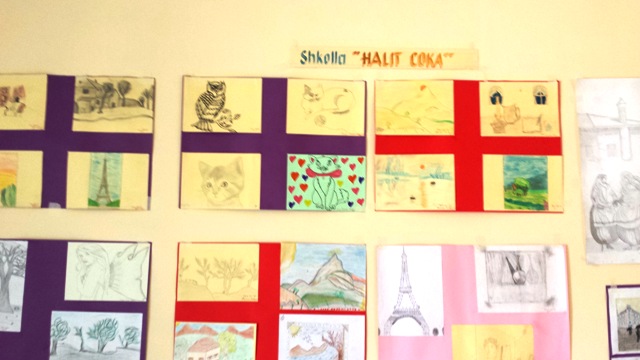
Special attention drew also the exposition with paintings of pupils from both schools. Many teachers and pupils from both schools visited that exposition. Teacher Dylber Mata, who was responsible for this exposition, as well as pupils themselves explained to them the main ideas and messages from most of them.
A detailed Workshop program, the Brochure “Elimination of Child Labour, an Important Trade Union Issue”, published in the framework of FSASH-SPASH Projects implementation, a special Brochure on Collective Agreement in power since 16 December 2016, as well as other publications, like SCREAM Modules, the Manual on Non Formal Education etc, where some of the materials of Workshop file provided to each participant. The Workshop was organised in three different sessions.
During the First Session, the Chairman of FSASH, Xhafer Dobrushi, was focused on advanced training and explanations on: Actual situation related to mobilisation of Albanian teachers to keep all children in school, special attention to those pupils who have emigrated abroad and are turned back in Albania, aiming to bring them again back in school, were also subject of discussions in this session. Concrete proposals were also made regarding further improvement of Albanian legislation, as well as further improvement of rules and regulations from the Ministry of Education, especially regarding pupils returned in school, after have been dropped out for long time, in order to give them possibility to pass the classes when they have good performance, independently by the number of lessons they have missed.
During the Second Session, the training specialist, Istref Haxhillari, made an advanced presentation on: SCREAM package - “Supporting Children’s Rights through Education, Arts and Media”, being focused especially on how can teachers and education trade union members, raise awareness of teachers and children against child labour and how teachers can use SCREAM Modules in their daily work, as well as on Non-Formal Education Manual, teaching methodology and so on. Explanations were accompanied with concrete exercises, especially regarding some other SCREAM modules, with interactive participation of teachers, parents and pupils present in the Workshop.
Third Session started with the Presentation from the Coordinator of Project implementation, Stavri Liko, on practical Guidelines about teachers trade unions engagement in child labour prevention and elimination and lessons learned from FSASH/SPASH commitment to prevent and eliminate child labour in these schools and wider, in Albania. Following, this session was focused on concrete situation of Project implementation, work done, results achieved, working methods used, conclusions and duties for the future and so on. This was the most important moment of the workshop regarding this Project implementation.
Heads of Monitoring Groups, Ilir Hoda, (“Halit Coka”) and Bukurosh Hoxha, (“Ahmet Zogu”) school, held detailed reports on the work done, problems faced, progress made and duties to make possible the realisation of Project objectives.
Teachers Shpresa Marqeshi, Anita Pula, Nimete Sokoli, Marije Frroku in “Halit Coka”, and Arta Uta, Izet Nabolli, Dhurata Vathi, Valentina Zhivanaj, in “Ahmet Zogu” school, spoke, on behalf of their respective Monitoring Groups, on the work done and results achieved, analysing one by one each pupils subject of Project implementation.
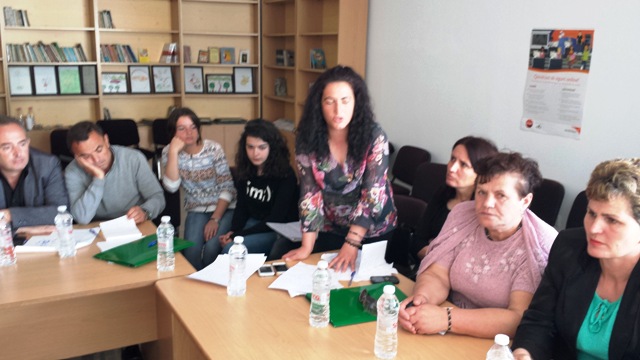
After that, it was an open discussions session, where other teachers, parents and pupils who took the floor, expressed their opinions on Project implementation activities, based on concrete experience they are gaining, also mentioning the results achieved and good examples of individual work with individual pupils.
Teacher Shpresa Marqeshi told the experience of their work with pupil Denis Fetiu. Financial difficulties of his family, constrained Denis to leave the school and start working to support the family. They are 4 children, out of whom 2 in the school and other 2 are under school age. Their mother does her utmost to provide for food, clothes and everything else needed, but it was impossible and that’s why Denis was asked to leave the school and start working. Under these circumstances, the Monitoring Group members were really active to find out ways how to assist the family. They collected some food and some clothes with the support of their classmates, they went to the family to talk with their mother and with pupils themselves, and after some time, Denis started to attend the school. Now he is attending the school regularly, also having good performance in learning.
Pupil Xhesika Pasha, told the experience with her classmate Asllan Zyba. Being from Roma community, Asllan was not feeling himself good in the classroom. Some times ago, he started to stay alone, not participating in class activities and at the end, he left the school. When his classmates understood what has happened with Asllan, they went home, talked to him and his family, invited him to participate in all activities they were organising with all their classmates, then Asllan understood that he is treated equal as all the others and now he is attending the school regularly, also having good relations with all other classmates.
Pupil Megisa Demiri told the experience with their classmate Daniel Fetiu. He has had many familiar problems, especially poverty in their family. The situation was worse when his father was sent to the prison. Then he left the school and started working. The Monitoring Group members and other classmates talked to him and to his mother, but it was not possible to convince them to bring him back in school. One day, his father was proclaimed not guilty and came back home, but Daniel was still continuing to work, not coming in school. Under this situation, they went again to his home, talked to his parents and convinced them to bring Daniel in school. Now everything is going on well with him in the school.
Other examples like these told also teacher Anita Pula, related to pupil Altin Alpapa, teacher Marije Frroku, related to pupil Ardit Rexhepi, teacher Arta Uta, related to pupil Albana Shupli and so on. Based on the figures mentioned during this session, the actual situation regarding the realisation of Project objectives is as follows: In “Halit Coka”” school, out of 15 pupils dropped out from school, 10 of them are withdrawn from working and turned back in school, while out of 39 pupils at risk to drop out from school, 32 of them are attending the school regularly, being considered out of risk to drop out from school and other 3 have made progress in attending the school. In “Ahmet Zogu” school, out of 17 pupils dropped out from school, 10 of them are withdrawn from working and returned in school and another 1 has made progress, being expected to be returned, meanwhile out of 53 pupils at risk to drop out from school, 42 of them are attending the school regularly and other 2 have made progress in attending the school.
As mentioned in previous information from Monitoring Groups meetings, it will be more difficult with the remained pupils dropped out from school, because most of them have emigrated with their families, some of them are girls, already married and the others have health problems or their families are in a very bad economic and financial situation.
The work is continuing with all other pupils still missing lessons hours per day or days per week.
This Workshop was an example on how to share experience between both schools and among Monitoring Groups’ members, on working methods, approaches used, results achieved and so on. Headmasters of both schools, as well as teachers, pupils and parents appreciated this support from GEW Foundation, mentioning the improvements done and results achieved and promising the continuation of their work to make possible this Project objectives realisation. Monitoring Groups meetings were also organised in the framework of these two days activities, where was discussed widely, especially regarding the preparations for the remained activities, especially the conclusive Round Table, which will be organised during the first 10 days of June 2016, as well as the work to be done and measures to be taken for those pupils still dropped out or those who still miss the school hours per day or days per week, until the end of this school year and the end of this Project implementation.
|